
CSTC Safety - CSTC Safety

Blog

Category Filtering: 'osha'

Remove Filter


Harvest Season Is Busy — Don’t Let Safety Compliance Get Overlooked
Posted by Terra Laverty
03 Sep 2026 02:02 PM


Harvest Season Is Busy — Don’t Let Safety Compliance Get Overlooked

Harvest season is one of the busiest times of year for California agriculture. With equipment running, crews working long hours, and operations moving at full speed, it can also be a time when workplace safety issues are easier to overlook.

At the same time, Cal/OSHA enforcement doesn’t slow down just because harvest is underway.

California Safety Training Corporation (CSTC) has worked with clients during harvest season to help identify and address potential compliance concerns before they lead to an employee injury, Cal/OSHA citation, or costly disruption to operations.

What Are We Looking For During a Safety Audit?

Our field and facility safety inspections focus primarily on Cal/OSHA compliance and conditions that have the potential to result in serious injuries or serious citations.

Rather than concentrating on routine HR or employee-file administration, our safety professionals look at what is actually happening in the workplace.

Some of the areas we may evaluate include:

  • Equipment and machine guarding
  • Harvest equipment and field operations
  • Employee safety training and safe work practices
  • Written safety programs and required procedures
  • Hazard identification and correction
  • Conditions or practices that could contribute to a serious employee injury
  • Observable Cal/OSHA compliance issues
  • Applicable food-safety-related conditions when they overlap with workplace safety
  • Whether established safety procedures are actually being followed in the field

This boots-on-the-ground approach can be especially valuable during harvest, when equipment use, staffing levels, working conditions, and production demands may be very different from the rest of the year.

Finding the Problem Before Cal/OSHA Does

One of the most valuable questions an employer can ask is:

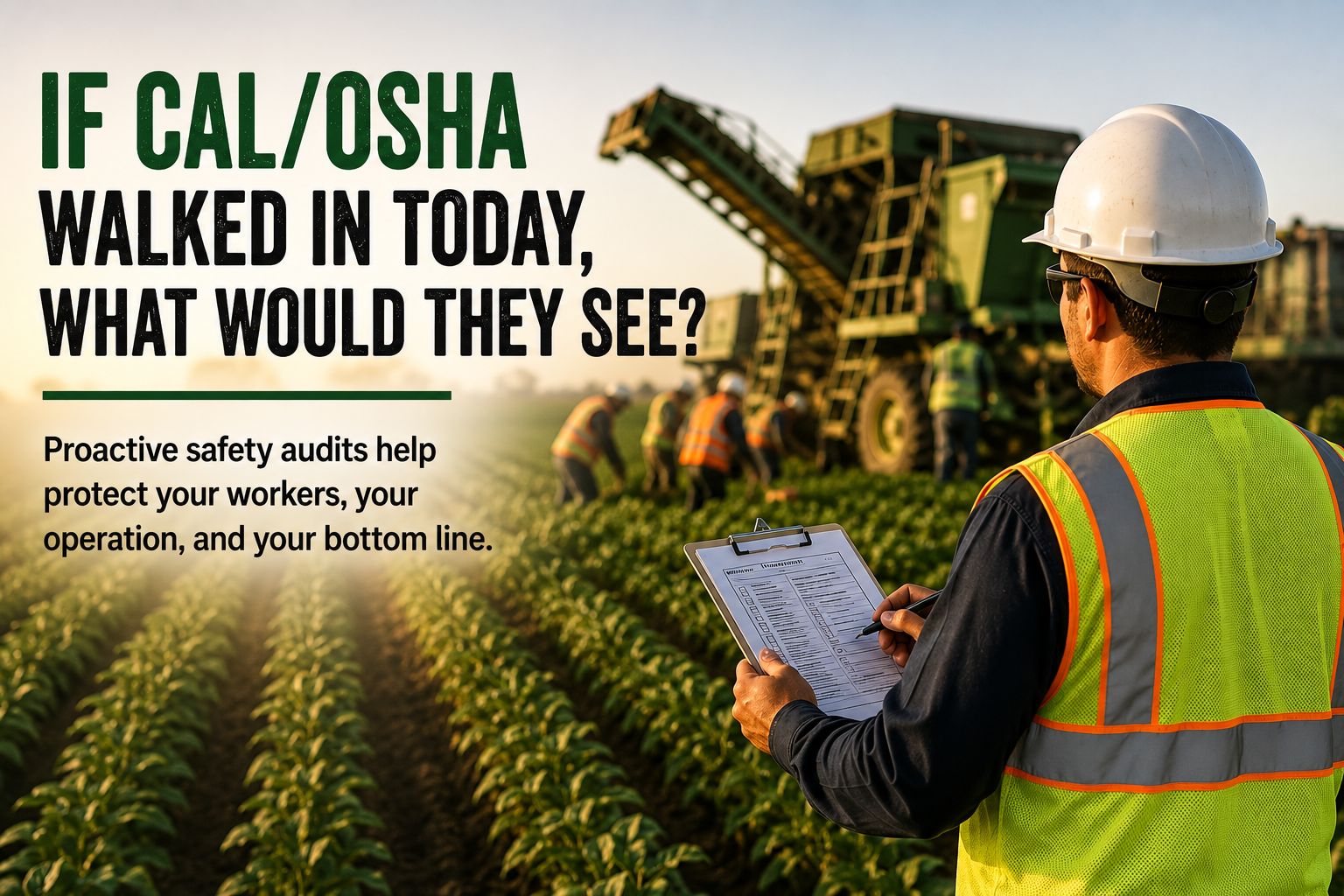
“If Cal/OSHA walked onto our property today, what would they see?”

A written safety program is important, but having a program on paper doesn’t necessarily mean the practices in the field match it.

For example, an employer may have procedures covering machine guarding, employee training, heat illness prevention, or equipment operation. But if an employee removes a guard, a supervisor allows an unsafe practice to continue, required training isn’t being applied, or a hazardous condition goes uncorrected, the employer may still have significant exposure.

An outside safety inspection provides another set of trained eyes to look at your operation from a compliance and injury-prevention perspective.

It’s About More Than Avoiding Citations

The goal of a safety audit shouldn’t simply be to prepare for Cal/OSHA.

The bigger goal is identifying conditions that could seriously hurt someone.

Many significant workplace incidents can be connected to hazards involving equipment, guarding, training, procedures, or unsafe practices that could potentially have been identified beforehand.

Finding those issues early gives employers an opportunity to correct them before someone gets hurt.

Start With One Field or Facility

A comprehensive safety program doesn’t have to begin with a long-term contract.

CSTC can start with a one-time field, facility, or harvest equipment safety inspection. This gives your organization an opportunity to see what we identify, review our recommendations, and determine whether additional services would provide value.

Depending on the size and scope of the operation, CSTC can perform individual site inspections or more extensive audits that include a detailed written report.

For agricultural operations in the middle of harvest, even one proactive inspection can provide valuable insight into conditions that may otherwise go unnoticed during the busiest part of the year.

A Trusted Safety Partner Since 1985

California Safety Training Corporation has been helping employers protect their workers and improve workplace safety for more than 40 years.

Our approach is practical: identify hazards, explain the compliance concern, and help employers determine what needs to be corrected.

Because at the end of the day, compliance matters — but everyone deserves to go home safe.

Is Your Operation Ready for a Safety Check?

If you’re in the middle of harvest or simply haven’t had an outside set of eyes evaluate your operation recently, now may be a good time.

Contact California Safety Training Corporation (CSTC) to discuss a field, facility, or harvest equipment safety inspection.

CSTC Safety
661-377-8300

Since 1985 — helping California employers build safer workplaces.
Lock Out Tag Out - Can you see what's wrong with this?

Posted by Terra Laverty
10 Oct 2024 03:07 PM

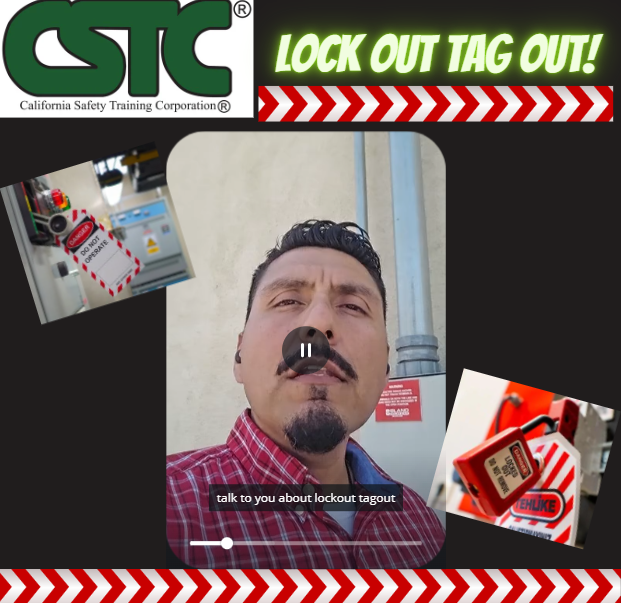
Can you see what's wrong with this lock out?  Click the link below and tell us in the comments.

Watch Now!

https://youtube.com/shorts/NdAZ7UV3KjE?si=cd5JWaP0-W2f3sSF


Workplace Violence Prevention Plan & Training

Posted by Terra Laverty
22 Apr 2024 01:04 PM


The deadline for implementing Workplace Violence Prevention Training and a Written Plan is fast approaching. Employers must ensure they have a robust written Injury and Illness Prevention Program (IIPP) and other safety and health initiatives in place to mitigate hazards and prevent workplace injuries and illnesses.

Starting from July 1, 2024, all employers, including those in construction, agriculture (such as farms, orchards, and vineyards), and other fields, must establish, implement, and maintain a comprehensive Workplace Violence Prevention Plan (WVPP).

Under this plan, all employees must undergo WVPP training during the initial rollout, as well as upon hiring, annually thereafter, and whenever there's a modification to the plan, an incident occurs, or a new violence hazard is identified, whether previously recognized or not.

For numerous employers, the Workplace Violence Prevention Program (WVPP) might seem straightforward due to their low-risk factors. Nonetheless, it's crucial to examine elements that could potentially endanger employees in the workplace and ensure that these are effectively addressed. Please reach out if you require assistance with your plan or training, or if you simply have a question. We're here to help.

Heat Illness prevention and compliance reminder

Posted by Terra Laverty
31 May 2023 01:43 PM

Heat Illness prevention and compliance reminder

I highly recommend formal Heat Illness Prevention training, which includes a test, supporting employees and supervisors in understanding their responsibilities under the heat illness regulation. 


When performing a Heat Illness program audit my top five elements that I look for include:

  1. Provide 1 quart of water per employee per hour.
  2. Be sure that shade and water is as close as practicable. Ideally within 300 feet.
  3. Make sure employees and supervisors understand symptoms, and that they have a right to take a break whenever they experience any symptoms.
  4. Make sure employees and supervisors know what acclimatization is. If there’s a new employee, Cal/OSHA is likely looking for a buddy system for the first 14 days during acclimatization.
  5. Make sure that you have your heat illness prevention program at the worksite. Sometimes this might mean having the heat illness prevention program in the vehicle or equipment that an employee is using to perform work at day as they may be working independently and not in a set location.


If you have any questions or would like to schedule Heat Illness Prevention training or a program audit please contact us.


Have a great and safe day.


Cal/OSHA Consultation Visits On The Rise

Posted by Terra Laverty
22 Jul 2022 06:59 PM

We have witnessed a rise in Cal/OSHA consultation visits and surprise enforcement inspections this year. Typically, these visits include an analysis of programs such as your Injury & Illness Prevention Program, Heat Illness Program, Training Program, and a walk-through inspection of your worksite.

To stay safe and be prepared, ensure your company safety programs are being implemented and are effective.  This means your programs are current and up to date, employees are experienced in the job being performed and employees have effective training in matters respective to their particular job assignments.

Your programs such as your IIPP and Heat Illness Program are required to be updated and reviewed annually at a minimum or whenever new substances, processes, procedures, or equipment are introduced to the workplace and represent a new hazard. These programs must be readily available for employees to access.

If Cal/OSHA Shows up:

SAFETY COACHING UPDATE SUBMITTED BY BEN W. LAVERTY, III, Ph.D., CSP, FACFE, REPA
 

1.Opening Conference: Issues to be reviewed.

  • a. Have IIPP available
  • b. Have training records available
  • c. Have disciplinary notice(s) available
  • d. Have 5 years of OSHA 300 Logs with current year included
  • e. Have 5 years of OSHA 300A Logs with current year included

2.  Escort Cal/OSHA person to incident scene using route least likely to offer the Cal/OSHA person a view of other operations.

3.  Be truthful and brief when answering questions.

4.  Do not share opinions on: injured individuals, (verbal or mutual), training programs, competency or supervisory personnel at time of inspection (get all available evidence first).

5.  Make copies of or note any statements made by Cal/OSHA inspector.

6.  If inspector takes a picture, a mirror image of that picture MUST BE taken by company personnel, developed, documented and put into the investigation file.

7.  Never argue with a Cal/OSHA representative.

8.  Do not ask if there will be a citation.

9.  Do not say that you think a citation should be written even if at the time you may think one is deserved. (Yet to be discovered evidence could change your mind…you will have difficulty in taking the statement back).

10.  Be on the alert for verbal entrapment. The inspector will often:

  • a. Ask, ask, ask – is the answer the same each time?
  • b. Implying “another” usually higher-ranking individual, said the facts were different.
  • c. Let Cal/OSHA expert draw and report on any preliminary conclusion, not you.
  • d. Don’t get hooked with “what do you think.” Answer with, “I’m holding off on making conclusions until I have all the information.”

11.Closing Conference: Listen and take notes.


Reminder: OSHA 300 Logs to be posted by tomorrow

Posted by Terra Laverty
31 Jan 2022 03:09 PM


Don’t forget to fill out, submit(as required) and post(Form 300A only) your OSHA 300 logs February 1 – April 30.  Forms can be found at https://www.osha.gov/recordkeeping/forms.

Recordables are an illness that is work-related and result in one of the following:

  • Death
  • Days away from work
  • Restricted work or transfer to another job
  • Medical treatment beyond first aid
  • Loss of consciousness
  • A significant injury or illness diagnosed by a physician or other licensed health care professional.

The forms must be filled out even if no recordable illnesses have occurred.


Cal/OSHA Ag COVID-19 Checklist, CSTC CSP COVID-19 Update, Worksite Specific COVID-19 Plan Checklist

Posted by Terra Laverty
07 Jul 2020 12:26 AM

Cal/OSHA has been visiting worksites and asking for and or utilizing the general checklist attached to enforce COVID-19 protocols.  Please see the link for the Cal/OSHA Ag checklist specific to COVID-19 and note that when the CSTC worksite specific document (see link) is utilized with the IIPP topic (see link) then the checklist items are addressed.


Cal/OSHA COVID-19 Checklist for Ag


IIPP-CSP COVID-19 Update 6.25.20


Worksite Specific COVID-19 Prevention Plan Checklist


We are here to support you.  Please reach out to any of our staff.


Stay Safe! Stay Healthy!


CSTC Team


COVID-19: The Rough... AND The Good

Posted by Terra Laverty
12 Jun 2020 12:03 AM

Two weeks ago I did a Zoom meeting presentation on COVID-19 for my business networking group here in Hawaii.  After sharing the PowerPoint with Ben (my brother and colleague), he thought it would be great to share with all of you.  If you would like to talk about any of the information in the slides or want further details of the presentation, please reach out to me.  I would love to share and chat. 


CSTC COVID-19 TLAV 5.2020


Stay Safe!  Stay Healthy!

We are all in this together!

Essential Industries with an employee who tests positive for COVID-19

Posted by Terra Laverty
05 May 2020 02:55 AM

Essential Industries with an employee who tests positive for COVID-19

  1. Isolate sick worker from other employees.
  2. Inform other employees while protecting privacy under HIPAA laws.
  3. Perform a contact tracing of the employee at your workplace for the previous 14 days including contractors and suppliers who may have been in close contact* with the infected worker.
  4. Sanitize surfaces which the worker may have touched including tools and transportation.
  5. Monitor employees who were potentially exposed. Ask daily about symptoms and potential exposures. Train employees to inform you if any symptoms appear while working and isolate any employee who has symptoms. Consider monitoring temperatures of employees.
  6. If contact tracing indicates the employee was exposed while working then recording (worker comp) and reporting to Cal/OSHA if the illness leads to a fatality, in-patient hospitalization or disfigurement.
  7. Review your companies code of safe practice for COVID-19 and review your infectious disease management plan and update as needed.

** Data is limited to define of close contact. Factors to consider when defining close contact include proximity (within 6 feet), the duration of exposure (e.g., longer exposure time likely increases exposure risk), whether the individual has symptoms (e.g., coughing likely increases exposure risk) and whether the individual was wearing a facemask (which can efficiently block respiratory secretions from contaminating others and the environment).


Sources: Cal/OSHA, CDC, OSHA, CA DHS and HHS

UPDATED COVID-19 Code of Safe Practice (E/S) for your IIPP replacing update from 4.6.2020

Posted by Terra Laverty
23 Apr 2020 02:12 AM

The CDC and Cal/OSHA regulations have been changing as the pandemic is progressing.  The Code of Safe Practice attached for COVID-19 reflects the most recent changes we are aware of.  In particular the return to work and quarantine guidelines have changed recently.  Please review and update your IIPP with this Code of Safe Practice.  If you have questions or need assistance in updating your programs please contact us.

IIPP CSP COVID-19 English 4.22.2020

IIPP CSP COVID-19 Spanish 4.22.2020

1 2 3 >>